Showing posts with label Reconstruction. Show all posts

Monday, September 9, 2019

Macheca organizes paramilitary 'club'

Group of 'white citizens' backs overthrow
of Republican government in Louisiana


On this date in 1874...

Joseph P. Macheca, a produce importer and steamship line owner allied with Louisiana conservative Democratic interests, on the evening of September 9, 1874, called to order an organizational meeting of the white supremacist Cosmopolitan Democratic Club of the City of New Orleans.

A press report by the Daily Picayune indicated that the meeting, held at Royal and Orleans Streets, drew a large number of "foreign citizens," including immigrants from Italy, Austria and Spanish-speaking countries. (The Royal and Orleans location is behind the landmark St. Louis Cathedral and about one city square from the Orleans Ballroom, where Macheca's violently racist Innocenti organization regularly met six years earlier.)

The group supported a resolution that was starkly racist:

Whereas it behooves all good citizens to take part in the approaching campaign, in order to redeem the State of Louisiana, and relieve her from the present usurpation - Be it resolved, That we, as white citizens, do form ourselves into a Democratic club, to be known as the "Cosmopolitan Democratic Club" of the city of New Orleans.

Daily Picayune, Sept. 10, 1874.
At the time - the Reconstruction period following the Civil War - a liberal Republican Party (known in the South as "Radical Republicans" and "Black Republicans") encouraged African American voter registration, while an entrenched conservative Democratic Party fought to maintain the status quo. Backed by President Ulysses Grant, a Republican-dominated Congress in Washington, D.C., and the federal military, Republicans controlled the postwar state government (the "present usurpation" referred to in the resolution). Within New Orleans, the Democratic establishment embraced white immigrants, then arriving in increasing numbers, in an effort to offset the new voting power of the Republicans.

When the Cosmopolitan Democratic Club elected officers, Macheca was selected as grand marshal. Today that position would be the ceremonial leader of parades, but it had a more military function in 1874. All present at the meeting must have recalled Macheca's leadership of bloody marches through African-American neighborhoods during the 1868 election season.

The military purpose of the Cosmopolitan Democratic Club became evident less than a week later, as "Captain Macheca" and his men participated in a large-scale insurrection against Republican state government. The revolt was organized by the Crescent City White League, a network of paramilitary groups (like the Cosmopolitan Democratic Club) that was led by former Confederate officers.

Macheca's force played a pivotal role in routing state militia and New Orleans Metropolitan Police in the September 14, 1874, conflict recalled as the Battle of Liberty Place. The victory was short-lived, as federal troops were quickly moved into New Orleans to restore Republican control.
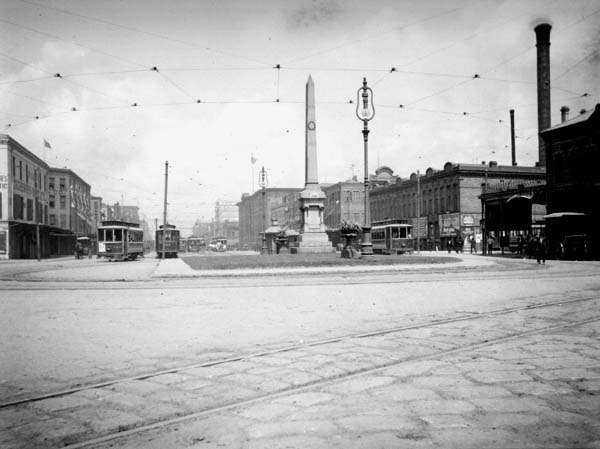
Monday, April 24, 2017

Liberty Place monument removed

Early this morning (Monday, April 24, 2017), city of New Orleans workers dismantled and removed the Liberty Place monument, commemorating the 1874 battle between local conservative militias and Louisiana's Reconstruction Era government.

The battle occurred after the validity of state election results was questioned by both major political parties. Rival election boards announced the election of different governors, and competing state legislatures were assembled.

Joseph P. Macheca, the subject of Deep Water: Joseph P. Macheca and the Birth of the American Mafia, captained a force of Sicilian immigrants that played a pivotal role in the battle and helped conservative Democratic "White League" forces to rout the well-armed Metropolitan Police, comprised largely of Republican-aligned African Americans and led by superintendent Algernon Badger, and a Republican militia commanded by former Confederate General James Longstreet.

Following the battle, U.S. President Ulysses Grant ordered federal troops into New Orleans to restore Reconstruction government control. The conflict has been referred to as the last battle of the U.S. Civil War. 


The monument - a 35-foot white stone obelisk - was installed in the center of Canal Street in 1891. (In the same year, Macheca and ten other men held at Orleans Parish Prison were attacked and murdered by a mob.) A white-supremacist message was inscribed upon the structure decades later. Controversy surrounded the monument and its racist inscription. That inscription was subsequently covered by a carved stone plaque dedicating the monument to those killed on both sides of the 1874 conflict.

Due to a Canal Street construction project 28 years ago, the obelisk was removed. There was a considerable argument over whether it should be replaced. Several years later, it was installed at a less visible location on Iberville Street. It remained a divisive symbol for the community.

The Liberty Place monument was the first of four Confederate Era monuments scheduled for removal in the city. New Orleans Mayor Mitch Landrieu told the press yesterday (April 23), "There's a better way to use the property these monuments are on and a way that better reflects who we are."

Read more:

Monday, September 9, 2013

1874: Organizing opposition to LA's Republican state government

On this date (Sept. 9) in 1874 - Joseph Macheca calls to order the first meeting of the Cosmopolitan Democratic Club in New Orleans. The group elects P. Torre Jr. as its president and Macheca as its grand marshal. The 'club' is a paramilitary order dedicated to the overthrow of Louisiana's Republican state government.

Similar organizations were forming throughout the New Orleans area in opposition to state and federal Reconstruction policies. Known collectively as the White League, the conservative Democratic forces soon would take up arms against state militia and police controlled by the Republican governor (Battle of Liberty Place).

Friday, November 23, 2012

Lincoln movie omissions

Something you won't find in the new Lincoln movie: The significant roles played by Lincoln, the Civil War and Reconstruction in the development of the first American Mafia organization, based in New Orleans.

Read: