Showing posts with label macheca. Show all posts

Tuesday, March 2, 2021

Disturbance at trial of accused killers

On this date in 1891, one of nine accused Mafiosi, standing trial in New Orleans for plotting and carrying out the assassination of Police Chief David Hennessy, created a sensation in the courtroom.

There had been just one day of prosecution testimony in the case, which began on Saturday, Feb. 28. Manuel Polizzi already had been identified by witnesses as one of the five gunmen who participated in the October 1890 murder of the police chief.

When brought into the courtroom with his codefendants on Monday morning, March 2, Polizzi hesitated to take his seat. He talked loudly in Italian and tried to get the attention of Judge Joshua Baker. Two deputies forced him to sit, but he once again stood and addressed Baker rapidly in his native tongue, waving his arms and punching at his own chest as he spoke. As a deputy attempted to force the defendant into his chair, Baker instructed, "Let him alone."


The judge asked defendant Charles Matranga (the reputed leader of the regional Mafia organization and an accused accessory to the Hennessy assassination) what was happening. Matranga replied only that Polizzi wanted an interpreter. "Talk to him and find out what he wants," Baker said. Matranga and Polizzi exchanged a few words, and Matranga told the judge, "He don't want to talk to me." Baker then attempted to use defendant Joseph Macheca (a politically influential, Mafia-linked businessman who also was an indicted accessory in the Hennessy killing) as an interpreter, but Polizzi was entirely unreceptive to that as well.

Before Baker could send for an independent interpreter, a defense attorney objected. "We would like an opportunity to speak to this man ourselves," attorney Lionel Adams said. "He is our client and it is our right."

Noting that Polizzi clearly had something he wished to express directly to the court, Baker brushed aside the complaint and sent for an interpreter. Baker met with Polizzi and the interpreter, as well as attorneys from both sides of the case, in his chambers.

Polizzi
Polizzi's statement to the judge was kept secret. However, when the group returned to open court, defense counsel Thomas J. Semmes announced that the defense team could no longer represent Polizzi. That appeared to confirm the widespread suspicion that Polizzi was turning state's evidence, but prosecutors apparently were unimpressed with the quality of Polizzi's statement and did not separate him from the case. Lead prosecutor Charles H. Luzenberg would not comment on the matter. (Though he did not speak of it, thanks to an undercover Pinkerton operative inserted into the Orleans Parish Prison with the defendants, Luzenberg possessed information others did not have about Polizzi's mental state and its underlying causes.)  Another defense attorney was selected to represent Polizzi, and the trial went on.

Polizzi was visibly afraid and tried to keep away from his codefendants. The court agreed to Polizzi's request to be held in separate quarters from the other accused.

Newspapermen learned that Polizzi made a confession "of a startling character" to Judge Baker, and they reported on his paranoid behavior. Defense attorneys told the press that Polizzi insisted both that he knew all about the conspiracy to murder Chief Hennessy and yet also took no part in the killing. They suggested that Polizzi was crazy. Reporters said they learned the defendant acknowledged being present when $4,000 was divided up among men selected to be the triggermen in the Hennessy assassination. He claimed, however, to have been at his home on Julia Street at the time witnesses saw him take part in the shooting of Chief Hennessy on Girod Street.

Just a few days after giving his statement to Judge Baker, Polizzi created an even greater disturbance, as he had an emotional breakdown in open court. When he was removed to the office of the sheriff, he attempted to throw himself through a closed window.

The trial continued until March 13, when a jury failed to reach agreement on the guilt of Polizzi and two other accused assassins and found the six remaining defendants not guilty. The New Orleans community became aware of evidence of jury tampering in the case, and Polizzi was one of eleven Italian inmates lynched at Orleans Parish Prison the next morning. Only much later was Polizzi's apparently irrational behavior at trial fully explained...


For more about this subject:
  Deep Water: 
  Joseph P. Macheca and the  
  Birth of the American Mafia
    by Thomas Hunt and 
    Martha Macheca Sheldon 
    (Second Edition, Createspace, 2010)

Sources:

  • "Desperate Politz," New York World, March 7, 1891, p. 1.
  • "Hennessy assassin confesses," New York Tribune, March 3, 1891, p. 1.
  • "Hennessy murder," New Orleans Times-Democrat, March 3, 1891, p. 6.
  • "Hennessy murder," New Orleans Times-Democrat, March 7, 1891, p. 3.
  • "The Hennessy case," New Orleans Daily Picayune, March 3, 1891, p. 3.
  • "Hennessy's murderers," St. Louis Post-Dispatch, March 6, 1891, p. 2.
  • "The Mafia at bay," St. Louis Post-Dispatch, March 3, 1891, p. 2.
  • "The New Orleans vendetta," New York Sun, March 3, 1891, p. 2.


Saturday, February 27, 2021

Jury complete, 1891 Mafia trial begins

A lengthy jury selection process concluded Friday, February 27, 1891, and the trial of nine men accused of the assassination of New Orleans Police Chief David Hennessy began with the reading of the indictment by Court Clerk Richard Screven.


Screven read: 

The grand jurors of the State of Louisiana, duly impaneled and sworn in and for the body of the Parish of Orleans, in the name and by the authority of the said state, upon their oath, present:
That one Peter Natali, one Antonio Scaffidi, one Antonio Bagnetto, one Manuel Politz, one Antonio Marchesi, one Pietro Monastero, one Bastian Incardona, one Salvador Sinceri, one Loretto Comitz, one Charles Traina and one Charles Poitza, late of the Parish of Orleans, on the 16th day of October, in the year of our Lord one thousand eight hundred and ninety, with force of arms,... feloniously did shoot and murder one David D. Hennessy with a dangerous weapon, to-wit, a gun, with felonious intent willfully, feloniously and of their malice aforethought, to kill and murder him...
And the grand jurors aforesaid, upon their oath foresaid, do further present that one Asperi Marchesi, one Joseph P. Macheca, one James Caruso, one Charles Matranga, one Rocco Geraci, one Charles Patorno, one Frank Romero and one John Caruso, before the said felony was committed in form aforesaid... did feloniously and maliciously incite, move, procure, aid, counsel, hire and command the said Peter Natali, the said Antonio Scaffedi, the said Antonio Bagnetto, the said Manuel Politz, the said Antonio Marchesi, the said Pietro Monastero, the said Bastian Incardona, the said Salvador Sinceri, and the said Loretto Comitz, one Charles Traina, and one Charles Poitza, the said felony in manner and form aforesaid...

Though the indictment contained charges against nineteen men, just nine of those were going on trial. District Attorney Charles H. Luzenberg handled the prosecution. The lead defense counsel was Lionel Adams.

Court adjourned at just after five o'clock in the afternoon. The start of testimony was scheduled for 10:30 the next morning, Saturday, February 28.


Through a period of twelve days, the court had summoned 1,221 prospective jurors. Of that number, 780 had been examined before the twelfth man of the panel could be placed.

A total of 557 men were prevented from jury service in the case for causes such as objecting to capital punishment, objecting to conviction based on circumstantial evidence, holding a fixed opinion in the case and exhibiting extreme prejudice against Sicilian-Americans. Physical disability excused ninety-five of those examined. The defense used 100 of its 108 peremptory challenges (twelve per defendant) against prospective jurors, while the prosecution used twenty-eight of its fifty-four peremptory challenges (half the total allowed to the defense).

The completed jury consisted of Jacob M. Seligman, jeweler, of 636 Carondelet Street; Solomon J. Mayer, real estate dealer, of 500 Franklin Street; John Berry Jr., flour company solicitor, of 137 Gravier Street; Walter D. Livaudais, Southern Pacific Railroad clerk, 209 1/2 Magazine Street; Henry L. Tronchet, cotton company clerk, of 411 Dauphine Street; William H. Leahy, machinist, of 439 Constance Street; Arnold F. Wille, grocer, of Lafayette and Franklin Streets; Edward J. Donegan, molder, of 299 1/2 St. Thomas Street; William Mackesy, bookkeeper, of 235 1/2 Julia Street; Charles Heyob, jewelry repairer, of 242 Royal Street; William Yochum, grocer, of Fourth and Dryades Streets; Charles Boesen, shoe company clerk, of 402 Customhouse Street.


The trial continued until Friday, March 13, when the jury returned with its verdicts. It found Bagnetto, Incardona, Macheca, the Marchesis and Matranga not guilty and could not reach a verdict on Politz, Scaffedi and Monastero. Suggestions that the jury had been bribed by agents employed by the defense were already being discussed in the community. The failure to convict anyone for the killing of the local police chief further incited the community.

Though not convicted, the nine case defendants could not be released until a related charge was dismissed. They were held overnight at Orleans Parish Prison, along with their untried indicted co-conspirators. Release of the acquitted defendants was expected to occur the next morning.

Overnight, however, political leaders hastily arranged a community mass meeting. On the morning of March 14, they stirred up a large crowd and swarmed the prison. A squad of gunmen penetrated the prison and murdered eleven of the prisoners held there, including six of the trial defendants.

See also:

Sources:

  • "A jury at last," editorial, New Orleans Daily Picayune, Feb. 28, 1891, p. 4.
  • "The jury complete," New Orleans Daily Picayune, Feb. 28, 1891, p. 1.
  • "The Hennessy Trial," New Orleans Daily Picayune, March 4, 1891, p. 1.
  • "None guilty!," New Orleans Daily Picayune, March 14, 1891, p. 1.
  • "The mass meeting," editorial, New Orleans Times-Democrat, March 14, 1891, p. 4.
  • "What next?" editorial, New Orleans Times-Democrat, March 14, 1891, p. 4.
  • "Juror Seligman and the state's attorney," editorial, New Orleans Daily Picayune, March 15, 1891, p. 4.
  • "Avenged," New Orleans Times-Democrat, March 15, 1891, p. 2.
  • "The dead buried," New Orleans Times-Democrat, March 16, 1891, p. 2.
  • State of Louisiana versus Peter Natali, et al, indictments, no. 14220, Nov. 20, 1890; no. 14221, Nov. 20, 1890; no. 14231, Nov. 22, 1890.

Read more in Deep Water: Joseph P. Macheca and the Birth of the American Mafia by Thomas Hunt and Martha Macheca Sheldon.

Tuesday, September 15, 2020

Martha Macheca Sheldon, author, 84

Martha Macheca Sheldon, award-winning author of a New Orleans underworld history/biography, died August 29, 2020, following a valiant battle against cancer. She was about two weeks shy of her eighty-fifth birthday.

Known to her many friends as “Marnie” and “Mardi,” Sheldon was coauthor of Deep Water: Joseph P. Macheca and the Birth of the American Mafia, published by iUniverse early in 2007. The book’s release – the culmination of more than a decade of research into her own family history – was celebrated with an April signing event at the Garden District Book Shop in New Orleans. Deep Water became silver medalist in the South Region Nonfiction category of the 2008 Independent Publisher Book Awards. A second edition of the book was released early in 2010.

Sheldon followed family roots to 19th century New Orleans. In that time and place, her Macheca ancestors were generally well-to-do, law-abiding entrepreneurs and pioneers of the fruit trade. Her ancestor, John Macheca, was a principal owner of the New Orleans-Belize Royal Mail and Central American Steamship Company, which transported Central American produce to U.S. ports and held a contract for delivery of mail to the British colony of Belize.

However, Sheldon learned that John’s half-brother, Joseph P. Macheca, had been the leading suspect in the 1890 Mafia assassination of New Orleans Police Chief David Hennessy and one of the victims in the 1891 Crescent City lynchings, the single largest lynching event in American history.

“I heard a lot about family history while growing up,” Sheldon remarked in 2007, noting that there had been no family discussion about Joseph P. Macheca. “When I learned there was a missing piece of the story, I was determined to find it. My father and other relatives wouldn’t talk about it. Over the years, I was able to pick up bits of information from various sources, until the skeleton was finally out of the closet.”

Sheldon was born Martha L. Macheca on September 14, 1935, in St. Louis County, Missouri. (The 1940 U.S. Census located the family home on Conway Road in Clayton Township.) Her parents were Arthur M. Jr. and Marie Lucks Macheca. She graduated from Villa Duchesne Sacred Heart High School and earned a bachelor of Fine Arts degree from Washington University in St. Louis. While at college, she met Stephen B. Sheldon, a St. Louis native (born November 27, 1931) and a veteran of the U.S. Marines. They were married in 1958. Stephen Sheldon became a highly regarded freelance cartoonist, animator and painter.

The Sheldons lived for a time in Los Angeles, California, where they worked in the production of television commercials for Gardner Advertising. Martha Sheldon also worked for an interior design company.

They later returned to their home city of St. Louis, where they raised their daughter Kate. Martha Sheldon’s favorite activities included tennis, spending time with family and communicating with friends. She became involved with volunteer work for SSM Cardinal Glennon Children’s Hospital, Malcolm Bliss Mental Health Center and Barnes Jewish/Christian (BJC) Hospital. She served on the Auxiliary Board of Directors at BJC, and was a member of the Risk Management Board, a Patient Representative Director and Public Relations Director. Stephen Sheldon set aside his art supplies in 1996 and became a dispatcher for the ranger base at the St. Louis Zoo.

At that time, Martha Sheldon began the research that would lead to Deep Water. Near the end of 2002, she communicated with Thomas Hunt, a Connecticut researcher then assembling a website dedicated to American Mafia history, and they shared information they had discovered about Joseph P. Macheca. They agreed in December 2002 to partner in the telling of Macheca’s life story and the events surrounding the 1890 Hennessy assassination. 

Tragedies struck just as their book was taking shape in 2005. Hurricane Katrina struck New Orleans in late August, imperiling Sheldon’s family and friends in the region as well as Macheca-related documents just discovered by New Orleans archivists. On October 28, 2005, Martha Sheldon’s husband of forty-seven years succumbed to pancreatic cancer at the age of seventy-three.

According to an online obituary, Martha Sheldon spent her last days at St. Sophia in St. Louis. She is survived by her daughter, Kate, and her brothers John Macheca and Arthur Macheca III. In addition to her husband Stephen, she was preceded in death by her sister Mariana O’Conner. 

Services were private. At Martha Sheldon’s request, her ashes were to be scattered under a full moon at the confluence of the Missouri and Mississippi Rivers. Donations may be made to the American Cancer Society.
 
Martha Sheldon (left) at a book signing event in St. Louis.


Sunday, January 5, 2020

New Orleans killing linked to Mafia feud

On this date in 1888...

A single pistol shot echoed along New Orleans' St. Philip Street at about ten o'clock in the evening of Thursday, January 5, 1888.

Times-Democrat
Private watchman Jacob Seither, stationed at the Old French Market at the foot of St. Philip, called for police assistance and then moved up the dark street toward the sound. Midway up the block, in front of a lodging house, Seither found twenty-eight-year-old Antonio Bonora, clutching a wounded abdomen and murmuring in Italian.

Police Officer Frank Santanio soon arrived and summoned an ambulance. He determined that Bonora was calling for his mother and asking for her blessing. Santanio asked Bonora who shot him, but the victim gave no answer. Bonora died before the ambulance arrived.

A stretcher was assembled from available materials, and it was used to take Bonora's body to the Third Precinct Station for examination. Police found a gaping wound in the upper abdomen and severe powder burns on the surrounding clothing and flesh. That indicated that the pistol had been placed quite close to the body when it was fired.

Investigators gained little helpful information from questioning residents of the Italian neighborhood where the killing occurred. In the front room of Salvatore Buffa's saloon, which looked out onto the street where Bonora was killed, police found several men gathered. Those men claimed they had been singing together and neither saw nor heard the nearby shooting.

Daily Picayune
Police learned that Bonora had been in the Buffa saloon earlier that night, sharing wine with local residents Sam Caruso, Vincent Pellegrini and Frank Demar. Caruso and friends reportedly tried to convince Bonora to take a drive with them uptown, but he refused. They parted a short time before the shooting.

Caruso, Pellegrini and Demar were rounded up by the police and brought to the police station. They viewed Bonora's body, but provided no useful information to investigators.

Deputy Coroner Stanhope Jones performed an autopsy on Bonora's remains on Friday morning. He found that death resulted from hemorrhage caused by a bullet that entered the body four inches above the navel and cut through the liver, spleen and right lung. The bullet traveled upward inside the body and lodged beneath the right armpit.

The local press reported that Bonora was a member of the Tiro al Bersaglio organization and the Fruit Laborers Union. Tiro al Bersaglio was an Italian-American benevolent society that hosted marksmanship events and had a paramilitary quality. Some of its more influential members, including Joseph Macheca and Frank Romero, were later linked with the local Mafia.

Related to Mafia conflict?

Bonora's murder was unsolved. But historians have pointed to Mafia enforcer Rocco Geraci as his killer. In the 1880s, the Sicilian underworld of New Orleans was divided into warring factions built around the rival Provenzano and Matranga families. It appears likely that Bonora's murder was related to this conflict. Geraci is also believed responsible for the earlier murder of Vincent Raffo in the same neighborhood.

The Provenzano group, known as the Giardinieri (or Gardeners) included Bonora's drinking buddies Pellegrini and Demar (a Provenzano brother-in-law) and, for a time at least, members of the Caruso family. Geraci was aligned with the Matrangas, known as the Stuppagghieri (or Stoppers). The Carusos appear to have abruptly abandoned the Provenzanos to side with the Matrangas, but they may have been secretly allied with the Matrangas all along.

The Provenzanos for years held a virtual monopoly over Sicilian dockworkers in New Orleans, controlling the Fruit Laborers Union. (In the later 1880s, Provenzanos held the posts of union vice president and financial secretary, while Victor Pellegrini served as union grand marshal.) A Provenzano-aligned stevedore firm held contracts to unload produce ships reaching the city docks.

In this period, a rival Matranga-Locascio firm sprang up and quickly seized control of the docks. A local newspaper report from summer 1888 indicated that the new company's "quick work and careful handling of the fruit" earned it high marks from importers and ship owners. At that moment, the Matranga business was said to include Charles Matranga, Antonio Locascio, James Caruso, Vincent Caruso and Rocco Geraci.

The Provenzanos did not accept the setback gracefully. More violence resulted, and local police, courts and political organizations were pulled into the gangland war.

See also:
Hunt, Thomas, and Martha Macheca Sheldon, Deep Water: Joseph P. Macheca and the Birth of the American Mafia.

Sources:
  • "From Spanish Honduras with fruit," New Orleans Times-Democrat, Aug. 26, 1888, p. 11.
  • "Fruit Laborers' Union," New Orleans Daily Picayune, Jan. 29, 1888, p. 6.
  • "Rocco Geraci," New Orleans Daily Picayune, July 27, 1890, p. 6.
  • "Slain," New Orleans Daily Picayune, Jan. 6, 1888, p. 2.
  • "The Benora autopsy," New Orleans Times-Democrat, Jan. 7, 1888, p. 3.
  • "The fruit laborers," New Orleans Times-Democrat, Jan. 29, 1888, p. 3.
  • "The Italian murder," New Orleans Daily Picayune, Jan. 7, 1888, p. 3.
  • "The vendetta," New Orleans Times-Democrat, Jan. 6, 1888, p 3.
  • "Trial of Garaci," New Orleans Times-Democrat, July 27, 1890, p. 10.

Tuesday, September 10, 2019

Macheca enlists as Confederate private

On this date in 1861: Joseph P. Macheca, a Louisiana native, enlisted in the Confederate Army. (Some legends incorrectly state that Macheca was foreign-born and sat out the Civil War.)


Signed up by Lieutenant John Devereaux of the Louisiana Artillery, Macheca became a private in Gomez's Company of the 22 Louisiana Infantry, Camp Lewis near New Orleans. At that time, it was thought that the war would be over quickly. Macheca's enlistment was for just nine months.

Macheca's term of service concluded just after the federal capture of New Orleans and just before the 22nd Regiment saw serious action. After leaving the army, he is known to have participated in black market activities during the federal occupation of the city and is believed to have helped run the Union blockade of southern ports.

Monday, September 9, 2019

Macheca organizes paramilitary 'club'

Group of 'white citizens' backs overthrow
of Republican government in Louisiana


On this date in 1874...

Joseph P. Macheca, a produce importer and steamship line owner allied with Louisiana conservative Democratic interests, on the evening of September 9, 1874, called to order an organizational meeting of the white supremacist Cosmopolitan Democratic Club of the City of New Orleans.

A press report by the Daily Picayune indicated that the meeting, held at Royal and Orleans Streets, drew a large number of "foreign citizens," including immigrants from Italy, Austria and Spanish-speaking countries. (The Royal and Orleans location is behind the landmark St. Louis Cathedral and about one city square from the Orleans Ballroom, where Macheca's violently racist Innocenti organization regularly met six years earlier.)

The group supported a resolution that was starkly racist:

Whereas it behooves all good citizens to take part in the approaching campaign, in order to redeem the State of Louisiana, and relieve her from the present usurpation - Be it resolved, That we, as white citizens, do form ourselves into a Democratic club, to be known as the "Cosmopolitan Democratic Club" of the city of New Orleans.

Daily Picayune, Sept. 10, 1874.
At the time - the Reconstruction period following the Civil War - a liberal Republican Party (known in the South as "Radical Republicans" and "Black Republicans") encouraged African American voter registration, while an entrenched conservative Democratic Party fought to maintain the status quo. Backed by President Ulysses Grant, a Republican-dominated Congress in Washington, D.C., and the federal military, Republicans controlled the postwar state government (the "present usurpation" referred to in the resolution). Within New Orleans, the Democratic establishment embraced white immigrants, then arriving in increasing numbers, in an effort to offset the new voting power of the Republicans.

When the Cosmopolitan Democratic Club elected officers, Macheca was selected as grand marshal. Today that position would be the ceremonial leader of parades, but it had a more military function in 1874. All present at the meeting must have recalled Macheca's leadership of bloody marches through African-American neighborhoods during the 1868 election season.

The military purpose of the Cosmopolitan Democratic Club became evident less than a week later, as "Captain Macheca" and his men participated in a large-scale insurrection against Republican state government. The revolt was organized by the Crescent City White League, a network of paramilitary groups (like the Cosmopolitan Democratic Club) that was led by former Confederate officers.

Macheca's force played a pivotal role in routing state militia and New Orleans Metropolitan Police in the September 14, 1874, conflict recalled as the Battle of Liberty Place. The victory was short-lived, as federal troops were quickly moved into New Orleans to restore Republican control.

Sunday, October 15, 2017

1890: New Orleans police chief ambushed, murdered

On this date (Oct. 15) in 1890, New Orleans Police Chief David Hennessy was fatally shot by several Mafia assassins a short distance from his home. He succumbed to his wounds the following morning.

Scene of Hennessy assassination

Hennessy attended a meeting of the city's police commission during the early evening of October 15. The meeting broke up at about nine o'clock. Hennessy was driven back to police headquarters at the southwest corner of Common (Tulane Avenue) and Basin Streets. Captain William O'Connor of the private Boylan Protection Agency met him there to escort the police chief home. Hennessy, perceived as a partisan in a local underworld feud, received a number of death threats from the local Mafia. City fathers hired the Boylan agency to keep him safe.

New Orleans Police Chief David C. Hennessy
Hennessy
Though Hennessy had a reputation for punctuality (he lived with his widowed mother and tried to avoid worrying her), the chief did not immediately head home. Instead, he and O'Connor, long acquainted, chatted at police headquarters for more than an hour. They left the building a few minutes after eleven.

While Basin Street was the most direct route between Hennessy's office and his home on Girod Street, heavy rains of earlier in the day had caused some flooding in the area. Hennessy and O'Connor took a significantly lengthier route, riverward on Common Street and then up Rampart Street to the intersection with Poydras Street. At that corner, the two men stopped into Dominick Virget's Oyster Saloon for a late snack. A teetotaler, Hennessy had a glass of milk with his plate of oysters.

At eleven-thirty, the men stepped out of Virget's and continued up Rampart Street. They paused in front of the McDonough schoolhouse at the corner of Rampart and Girod, about one and a half city squares from Hennessy's home. O'Connor said goodbye to Hennessy at that point, though he had been assigned with seeing the chief all the way home. O'Connor crossed the intersection diagonally to his left - his intended destination is unknown - while Hennessy turned right on Girod.

The chief took only a few strides and then halted as a young man darted out of a Girod Street doorway and ran toward Basin Street whistling loudly. The youth turned right onto Basin and disappeared around the side of Mrs. Ehrwald's second-hand store.

Hennessy assassins fired from beneath shed roof
The assassins' first
shots were fired from
beneath this shed roof
Hennessy managed just a few steps more. As he reached the front of the residence at No. 269 Girod Street, shotgun pellets tore into him from his left. The initial blast, originating from the darkness under a shed roof on the opposite site of Girod, shredded his umbrella, disabled his left hand and knocked him backward. Hennessy instinctively drew his ivory-handled Colt revolver. Another blast of shotgun pellets ripped through his slacks and shattered his right knee. On his way to the ground, the chief was struck by pellets in the chest and abdomen and then in the face and neck. Hennessy fired his revolver into the darkness across the street as he struggled to stand up.

Two shadowy figures stepped into Girod Street. Illuminated by a streetlamp and within sight of some residents whose attention was caught by the gunshots, they advanced toward the fallen police chief. They fired large-caliber slugs into Hennessy's midsection and then ran off.

Mortally wounded, Hennessy managed to rise to his feet. He stumbled a few yards in the direction of home. At the corner, he turned onto Basin. He dragged his disabled leg just a few more paces and collapsed onto the front steps of No. 189 Basin Street. Captain O'Connor, at most only a single square away when the gunfire erupted, somehow reached the chief's side far too late to fulfill his function as bodyguard.

"They gave it to me," Hennessy gasped, "and I gave it back the best I could."

O'Connor asked if the chief could identify his attackers. Hennessy reportedly replied, "Dagoes."

 - - - 

Hennessy died before he could provide any additional identification of his killers. Suspected Mafia members and associates were arrested and charged with conspiring in the assassination of the police chief. Nine men, including New Orleans-born businessman Joseph P. Macheca, were the first to be brought to trial early in 1891.

Captain William O'Connor, who should have been the prosecution's key witness in the case, was never called to testify. O'Connor might have explained the timing and the route of Hennessy's walk home, factors that brought him late at night into a well-planned ambush. The captain also might have explained his own fortuitously timed departure from the chief's side - just seconds before the shooting began - and his slow return to the chief after the shooting had finished and the assassins had run off.

None of the accused men were convicted. Six of those tried, including Macheca, reputed Mafia boss Charlie Matranga, and Asperi Marchesi, the boy-lookout who whistled upon the arrival of Hennessy, were acquitted. The jury could not reach a verdict for three other defendants identified by witnesses as shooters of the police chief.  After the trial, some jurors revealed that they had been concerned that Captain O'Connor did not testify.

Angered by the jury verdict, a mob stormed Orleans Parish Prison on the morning of March 14, 1891, and murdered Macheca and ten other prisoners.

 - - - 

Read more about Police Chief Hennessy
and the early Mafia of New Orleans:


Deep Water:
Joseph P. Macheca and the Birth of the American Mafia

by Thomas Hunt and Martha Macheca Sheldon
(Available in softcover and Kindle e-book formats)

Monday, August 28, 2017

Macheca and the black market

On this date (Aug. 28) in 1863, Joseph Macheca of New Orleans was tried and convicted in a Union military occupation court in connection with a scheme to steal and sell barrels of U.S. Army pork and beef.

Daily Picayune
The barrels officially belonged to the 4th Massachusetts Regiment. They had been loaded aboard the steamship North America, a government transport, at Port Hudson, Louisiana (recently fallen to the Union forces after a 48-day siege). The North America steamed its cargo up the Mississippi River in support of the 4th Massachusetts' advance to Cairo, Louisiana. Remaining barrels were brought to New Orleans, and the ship captain and a steward sold some to Macheca for resale through the Macheca family produce store in the city.

While other conspirators were sent to prison, young Macheca was merely ordered to pay a $50 fine.

Joseph Macheca previously had enlisted for service in the Confederate Army and returned home to New Orleans in advance of the Union invasion of the city. Union occupiers generally controlled businesses and provisions in the region. The produce business of Macheca's step-father - a native of Malta and a British citizen - was one exception.

Following his conviction, Macheca left New Orleans for Texas, where he reportedly gathered a small fortune through smuggling. Macheca returned after the Civil War and became a close ally of New Orleans Mafiosi while building a produce business and a shipping line.

Macheca was among those charged, tried and acquitted of the 1890 assassination of Police Chief Hennessy. The New Orleans merchant was one of eleven prisoners murdered after Orleans Parish Prison was stormed by an anti-Mafia mob in 1891.

Monday, April 24, 2017

Liberty Place monument removed

Early this morning (Monday, April 24, 2017), city of New Orleans workers dismantled and removed the Liberty Place monument, commemorating the 1874 battle between local conservative militias and Louisiana's Reconstruction Era government.

The battle occurred after the validity of state election results was questioned by both major political parties. Rival election boards announced the election of different governors, and competing state legislatures were assembled.

Joseph P. Macheca, the subject of Deep Water: Joseph P. Macheca and the Birth of the American Mafia, captained a force of Sicilian immigrants that played a pivotal role in the battle and helped conservative Democratic "White League" forces to rout the well-armed Metropolitan Police, comprised largely of Republican-aligned African Americans and led by superintendent Algernon Badger, and a Republican militia commanded by former Confederate General James Longstreet.

Following the battle, U.S. President Ulysses Grant ordered federal troops into New Orleans to restore Reconstruction government control. The conflict has been referred to as the last battle of the U.S. Civil War. 


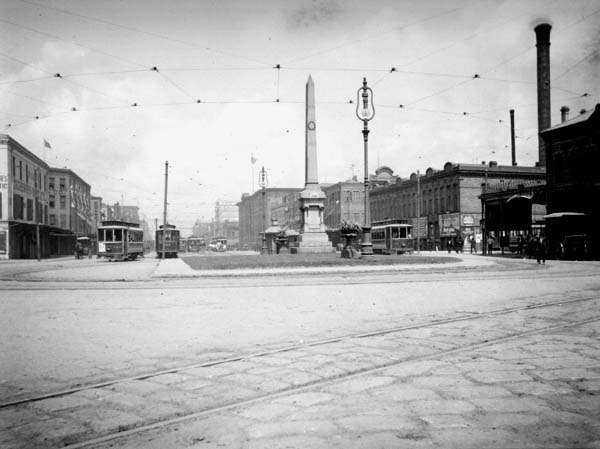
The monument - a 35-foot white stone obelisk - was installed in the center of Canal Street in 1891. (In the same year, Macheca and ten other men held at Orleans Parish Prison were attacked and murdered by a mob.) A white-supremacist message was inscribed upon the structure decades later. Controversy surrounded the monument and its racist inscription. That inscription was subsequently covered by a carved stone plaque dedicating the monument to those killed on both sides of the 1874 conflict.

Due to a Canal Street construction project 28 years ago, the obelisk was removed. There was a considerable argument over whether it should be replaced. Several years later, it was installed at a less visible location on Iberville Street. It remained a divisive symbol for the community.

The Liberty Place monument was the first of four Confederate Era monuments scheduled for removal in the city. New Orleans Mayor Mitch Landrieu told the press yesterday (April 23), "There's a better way to use the property these monuments are on and a way that better reflects who we are."

Read more:

Saturday, April 1, 2017

New Orleans underworld boss murdered

On this date (April 1) in 1869, New Orleans Mafia boss Raffaele Agnello was shot to death during an underworld feud. 
New Orleans Crescent, April 2, 1869.

Agnello, accompanied by his godson and bodyguard Frank Sacarro, was on a walk around the French Quarter when a noise from Old Levee Street behind him caught his attention. When he turned back to resume his walk, a bareheaded man in a long frock coat stepped forward and pointed a brass-mounted blunderbuss pistol at the boss's head.

The pistol fired, launching chunks of metal into Agnello's skull and killing him instantly. Some of the blunderbuss's projectiles missed the mark and cracked through the windows and walls of the Joseph Macheca produce store and the Norman & Reiss bakery on Toulouse Street. Sacarro's left index finger was wounded when he thrust out his left hand toward the weapon as it fired.

The gunman in the frock coat fled through the bakery pursued by Sacarro, who drew a pistol and managed to wound him with a shot. The gunman, leaving behind a trail of blood, escaped through a rear exit. Frank Philips, a baker working at Norman & Reiss, was wounded in the right leg by some flying lead.

In the summer, authorities arrested Joseph Florada (who may also have been known as Gaetano Arditto) as a suspect in the Agnello killing. Sacarro would not identify the Florada as the man he saw shoot his godfather, and the suspect was set free.

Agnello had been leader of a Mafia organization comprised of Palermitani. His enemies, an alliance largely made up of Messinesi and Trapanesi, had a momentary advantage in an underworld struggle that had already lasted several months, since the killing of Litero Barba, reputed leader of a Messinian gang. The war was not yet over, however. Raffaele Agnello's brother Joseph stepped up to the leadership of the Palermitani and continued the fight until his own murder in 1872.


For more about this subject:

Saturday, March 14, 2015

Eleven prisoners killed


On this date (March 14) in 1891: 

One day after a jury refused to convict the accused assassins of New Orleans Police Chief David Hennessy, an angry mob assembles on Canal Street. Under the direction of political leaders, the mob marches to Orleans Parish Prison, where the Hennessy assassination defendants remain incarcerated on a legal technicality. A carefully selected and well armed execution squad, numbering about a dozen, enters the prison to murder eleven men, including city businessman Joseph P. Macheca. 

The list of victims contains the names of six of the men who were tried but not convicted for the 1890 murder of local Police Chief David Hennessy and five others who were charged but not yet tried for that crime.

The execution squad moves quickly through the prison. It first drags one prisoner outside for public hanging, then traps and shoots three prisoners in an upstairs prison hall. Seven prisoners are cornered in the prison yard. As the unarmed men plead for mercy, the execution squad opens fire with repeating rifles at close range. One of the targets survives the shooting, and he is dragged outside to be hanged. Another prisoner, unconscious and mortally wounded from the shooting in the upstairs hall, remains alive for hours.

The two hangings outside the prison are performed sloppily, and several attempts are made before the victims' lives are finally extinguished.

The execution squad and its political leaders describe their eleven victims as members of the New Orleans Mafia. However, recognized Mafia leader Charles Matranga and his chief lieutenant - both held within the prison at the time - are spared. 


Friday, March 13, 2015

None convicted in Mafia murder trial

Court Clerk Richard Screven reads the jury verdict
in Judge Joshua Baker's courtroom.
On this date (March 13) in 1891: The trial of nine men accused of the assassination of New Orleans Police Chief David Hennessy concludes without a conviction. Much of the city is enraged as the jury acquits six defendants and announces a deadlock on the remaining three. 

Joseph P. Macheca, Charlie Matranga, Bastiano Incardona, Antonio Bagnetto, Antonio Marchesi and Asperi Marchesi are acquitted. A mistrial is declared for Manuel Polizzi, Antonio Scaffidi and Pietro Monastero.

The defendants, all widely suspected of membership in the Mafia criminal society, continue to be held at Orleans Parish Prison overnight on a legal technicality. Their release is expected the following day.

City political leaders hastily arrange for a morning gathering of New Orleans residents on Canal Street.

Saturday, September 14, 2013

1874: Armed rebellion in New Orleans

On this date in 1874, Joseph Macheca played a critical role in the White League victory over a militia/Metropolitan Police force controlled by Louisiana's Reconstruction Era state government. The conflict stemmed from contested elections that resulted in the creation of competing state administrations and legislatures.


Following failed negotiations, Republican forces led by former Confederate General James Longstreet and Metropolitan Police "General" Algernon Badger moved several thousand men into position on the downtown side of Canal Street. Badger commanded hundreds of Metropolitan Police, along with 12-pound cannons and Gatling guns, in a location between the Customs House and the levee.

The White League paramilitary forces assembled uptown and hoped to lure Republican forces from their positions at the edge of the French Quarter. Shouted taunts, snipers and a quick attack and retreat failed to entice Longstreet into an advance.

Captain Macheca's Company B of Second Regiment "Louisiana's Own" made the decisive move. Using an approaching train as cover, Macheca's 300 men (the roster of his Company B at Jackson Barracks Military Museum lists only 120) advanced along the levee and flanked Badger's position.

As Company B swarmed in from the levee, most of Badger's men fled back into the French Quarter. Badger himself fell wounded and was protected from further injury by Macheca and his men. (Some wished to hang the wounded Badger as a traitor.)

Though Republican positions melted away into the French Quarter, the White League did not pursue. The White League victory was not complete until the following morning, Sept. 15, when White League Colonel Angell began to probe across Canal Street. In the French Quarter, Macheca's men were found to be in possession of key Republican positions, thousands of seized weapons and two artillery pieces, and hundreds of surrendered prisoners.

Democratic forces retained control only for a short time, as President Grant moved the federal military into the area to support the return of the Republican government. White League supporters, viewing the conflict in New Orleans as a battle against oppression, later named the fight, "the Battle of Liberty Place."

A number of Macheca's men later became key figures in the New Orleans Sicilian business community and the Sicilian underworld organization.


Read more about the Battle of Liberty Place and the early days of the American Mafia in New Orleans - Deep Water: Joseph P. Macheca and the Birth of the American Mafia

Monday, September 9, 2013

1874: Organizing opposition to LA's Republican state government

On this date (Sept. 9) in 1874 - Joseph Macheca calls to order the first meeting of the Cosmopolitan Democratic Club in New Orleans. The group elects P. Torre Jr. as its president and Macheca as its grand marshal. The 'club' is a paramilitary order dedicated to the overthrow of Louisiana's Republican state government.

Similar organizations were forming throughout the New Orleans area in opposition to state and federal Reconstruction policies. Known collectively as the White League, the conservative Democratic forces soon would take up arms against state militia and police controlled by the Republican governor (Battle of Liberty Place).

Wednesday, August 28, 2013

1863: Macheca and the black market

150 years ago today (Aug. 28, 1863), Joseph Macheca of New Orleans was tried and convicted in a Union military occupation court in connection with a scheme to steal and sell barrels of U.S. Army pork and beef.

Daily Picayune
The barrels were traced to the 4th Massachusetts Regiment. They had been loaded aboard the steamship North America, a government transport, at Port Hudson, Louisiana (recently fallen to the Union forces after a 48-day siege). The North American steamed its cargo up the Mississippi River in support of the 4th Massachusetts' advance to Cairo, Louisiana. Remaining barrels were brought to New Orleans, and the captain and a steward sold some to Macheca for resale through the Macheca family produce store in the city.

While other conspirators were sent to prison, young Macheca is merely ordered to pay a $50 fine.

Joseph Macheca previously had enlisted for service in the Confederate Army and returned home to New Orleans in advance of the Union invasion. The Union occupiers generally controlled businesses and provisions in the region. The produce business of Macheca's step-father - a native of Malta and a British citizen - was one exception.

Following his conviction, Macheca left New Orleans for Texas, where he reportedly gathered a small fortune through smuggling.

Read more about Joseph Macheca: Deep Water: Joseph P. Macheca and the Birth of the American Mafia


Thursday, March 14, 2013

122 years ago: Eleven men lynched

March 14, 1891
One day after a jury refused to convict the accused assassins of New Orleans Police Chief David Hennessy, an angry mob assembles on Canal Street. Under the direction of political leaders, the mob marches to Orleans Parish Prison, where the Hennessy assassination defendants remain incarcerated. A carefully selected and well armed group enters the prison and murders eleven men, including Joseph P. Macheca. The victims are described as members of the New Orleans Mafia. However, recognized Mafia leader Charles Matranga and his chief lieutenant - both held within the prison - are spared. 

Sunday, October 28, 2012

144 years ago: Innocenti control the streets

144 years ago: Returning home from a meeting of Joseph Macheca's paramilitary Innocenti organization, a prominent member is shot to death by an unknown assailant. The Innocenti direct their anger at African American neighborhoods in New Orleans. They take over the streets around the Treme Market, pushing out police patrols. Federal officials later send two companies of soldiers to the area to restore order.

Wednesday, October 24, 2012

Innocenti raids begin

On this date in 1868...

Joseph P. Macheca, a native Louisianan engaged in importing and selling Central American produce, began (Oct. 24, 1868) leading a conservative, Democratic Party-aligned paramilitary group on violent anti-Republican marches through New Orleans.

The marches of the "Innocenti" organization were designed to suppress African American voter registration and election turnout for the then-liberal (often branded "radical") Republican Party. Repeated through several days, the marches led to bloody clashes in some of the Crescent City's African-American neighborhoods.

Macheca's role as director of the marches was screened somewhat by the Innocenti selection of Pascalis Labarre, a local official, as president of the organization. When later questioned, Labarre admitted knowing very little about the group's founding and purpose.

Thursday, January 19, 2012

Strange True Tours - New Orleans


Jeffery Holmes, who conducts Strange True Tours New Orleans, wrote to let us know that the Macheca family burial site in St. Louis Cemetery No. 2 will be incorporated into his tours this summer.

Sunday, August 28, 2011

148 years ago: Macheca and the black market

One hundred and forty eight years ago on this date, young Joseph P. Macheca of New Orleans was tried and convicted before a Union military court of selling stolen army rations.

Macheca, by then a veteran of Confederate service in Louisiana, was found selling U.S. Army-labeled barrels of pork and beef through his stepfather's produce store. He and some conspirators were tried before a military tribunal on Aug. 28, 1863. While Macheca's conspirators - members of the Union occupying force in New Orleans - were sentenced to prison time, Macheca was subjected only to a $50 fine.

Soon after, Macheca left New Orleans for Texas, where he gathered a small fortune as a smuggler.